
Three Views of a Dream


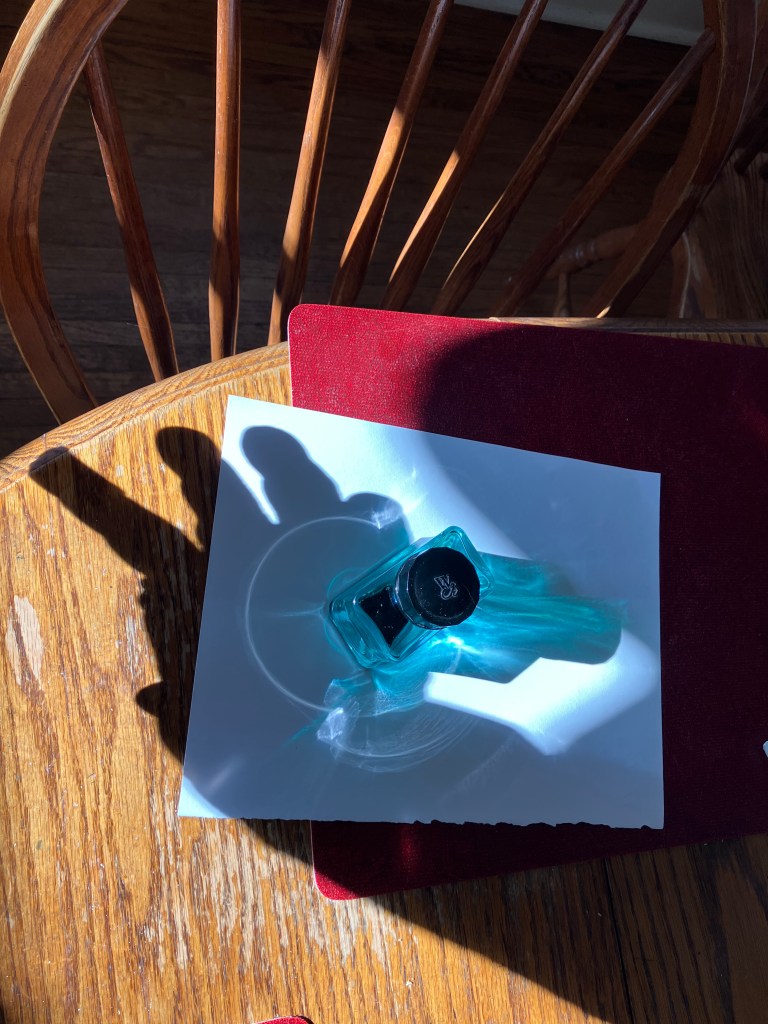
All the branches of art; painting, sculpture, music and writing, have a scientific side. They can be deconstructed into their constituent parts and with a fair degree of accuracy, distilled down into theories or formulas that describes the functioning of these parts in creating a coherent whole. Even in its precise definitions, dry language, and matter of fact concepts, the science of art has its own peculiar form of artistry. One that is easily overlooked.
Light is electromagnetic radiation that can be perceived by the human eye. Visible light spans the visible spectrum and is usually defined as having wavelengths in the range of 400–700 nanometers (nm), corresponding to frequencies of 750–420 terahertz.
Green is the color between cyan and yellow on the visible spectrum. It is evoked by light which has a dominant wavelength of roughly 495–570 nm In subtractive systems, used in painting and color printing, it is created by a combination of yellow and cyan; in the RBG color model, used on television and computer screens, it is one of the additive primary colors, along with red and, which are mixed in different combinations to create all other colors.
Shadow is a dark area or shape produced by a body coming between rays of light and a surface.
Time is the continuous progression of our changing existence that occurs in an apparently irreversible succession from the past, through the present, and into the future. It is a component quantity of various measurements used to sequence events, to compare the duration of events (or the intervals between them), and to quantify rates of change of quantities in material reality or in the conscious experience
Glass is a hard, brittle substance, typically transparent or translucent, made by fusing sand with soda, lime, and sometimes other ingredients and cooling rapidly. It is used to make camera lenses, ink bottles, other articles.
Archaeological evidence suggests glassmaking dates back to at least 3600 BC in Mesopotamia, Egypt, or Syria. The earliest known glass objects were beads, perhaps created accidentally during metalworking or the production of faience, which is a form of pottery using lead glazes.
Paper is a thin sheet material produced by mechanically or chemically processing cellulose fibers derived from wood, rags, grasses, herbivore dung, or other vegetable sources in water.
The oldest surviving piece of paper in the world is made of hemp fibers, discovered in 1957 in a tomb near Xian, China, and dates from between the years 140 and 87 BC. Papermaking was regarded by the Chinese as so valuable that they kept it secret as long as they could.
Wood is a structural tissue/material found as xylem in the stems and roots of trees and other woody plants. It is an organic material – a natural composite of cellulosic fibers that are strong in tension and embedded in a matrix of lignin that resists compression. Wood is sometimes defined as only the secondary xylem in the stems of trees, or more broadly to include the same type of tissue elsewhere, such as in the roots of trees or shrubs. In a living tree, it performs a mechanical-support function, enabling woody plants to grow large or to stand up by themselves. It also conveys water and nutrients among the leaves, other growing tissues, and the roots.
Archaeologists have uncovered evidence of the oldest wooden structure on record: a pair of interlocking logs connected by a notch that date to 476,000 years ago. Discovered along the Kalambo River in Zambia, the simple construction predates the first appearance of Homo sapiens in Africa.
Plastic is a synthetic material made from a wide range of organic polymers such as polyethylene, PVC, nylon, etc., that can be molded into shape while soft and then set into a rigid or slightly elastic form.
In 1907 Leo Baekeland invented Bakelite, the first fully synthetic plastic, meaning it contained no molecules found in nature. Baekeland had been searching for a synthetic substitute for shellac, a natural electrical insulator, to meet the needs of the rapidly electrifying United States. Bakelite was not only a good insulator; it was also durable, heat resistant, and, unlike celluloid, ideally suited for mechanical mass production. Marketed as “the material of a thousand uses,” Bakelite could be shaped or molded into almost anything, providing endless possibilities.
Photographer (the Greek φῶς (phos), meaning “light”, and γραφή (graphê), meaning “drawing, writing”, together meaning “drawing with light”) is a person who uses a camera to make photographs.
The birth of photography occurred in 1839 when Louis Daguerre and William Henry Fox Talbot introduced daguerreotype and calotype processes, respectively. Daguerre’s method, using silvered copper plates, became the commercial standard until the 1850s. Talbot’s calotype process, utilizing paper negatives for mass reproduction, laid the foundation for future photography.
 Prairie Beacon