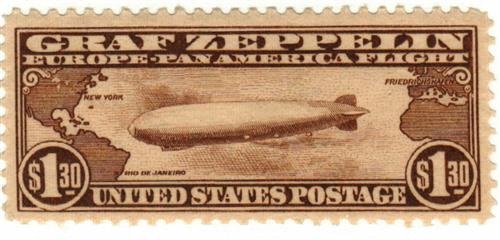
This week we feature the Graf Zepplin Issue of 1930. The three stamps of this issue were printed by the Bureau of Printing and Engraving using a flat plate printing method. The United States Post Office produced a set of three airmail postage stamps that commemorated the Graf Zeppelin,the first European-Pan-American round-trip flight in May of 1930. All three stamps were first issued in Washington D.C. on April 19, 1930, one month before the historic transatlantic first flight was made. The stamps were also placed on sale at other selected post offices on April 21, 1930.
The sixty-five cent denomination applied to a postcard making the transatlantic trip. The one dollar and thirty cent denomination applied to a letter making that same trip and the two dollar and sixty cent denomination was for a letter to make a round-trip on the zeppelin.
A total of 1,000,000 of each stamp denomination was printed, but only 227,260 stamps in all were actually sold, or 7% of the total amount printed. The Zeppelin stamps were withdrawn from sale on June 30, 1930, and the remaining stocks were destroyed by the Post Office. (Why the Post Master General sold these for an unusually short time, and destroyed the unsold stamps, I have found no answer to.)
This short window of opportunity to purchase and selected locations had made this a valuable issue. Also, the $4.55 price tag to purchase all three was not affordable to most collectors in the depths of the Great Depression.
These factors, combined with the destruction of the unsold stamps, had outraged most stamp collectors. An avalanche of complaint letters to the United States Postal Service ensued.
This issue today is considered the rarest of all U.S. Airmail stamps.
Happy Collecting!
Many thanks to Wikipedia, Mystic Stamps and the Scott Catalog for some of the information used in this post.
Writing these Stamp of the Week posts has motivated me to increase my philatelic knowledge. But until I have the deep reservoir needed to be considered a wise old man of stamps, I have to relay on the expertise of others.
If you have a minute can you help me out? Here is my situation.
Jefferson 1 cent, Scott#1278 / A710, Prominent American Series
As you can see, some of Jefferson’s image appears on the back side of the stamp.
What caused this to happen? Could this be considered a freak or an oddity?
I have searched for other examples of this but have found none.
If you have any knowledge on this topic please email me or post a comment.
I found a photo of the same radio! Thanks, Robot Man.
I started listening to the radio before I was in grade school.
My mom had a small plastic AM clock radio that she put on top of our refrigerator.
When she was on the phone in her bedroom, I would push a chair against the fridge, turn it on, and search through the stations.
I settled on WABC, the top forty station broadcasting out of New York City. It was our hometown station because the city started just one block from my house.
After a few weeks of this, my mom got tired of turning the dial back on her station, WNEW and The Make-Believe Ballroom. She bought a new radio and gave the GE clock radio to me.
The new radio did not have to go up on the refrigerator.
I put the radio on the windowsill of my bedroom. At night I would listen to music while I looked out at the windows of the other apartment houses and wonder what the tenets were doing. I watched cars go by in the street and wondered where they were off to in the dark of the city. I watched the older kids running around in the street and wondered what they were up to.
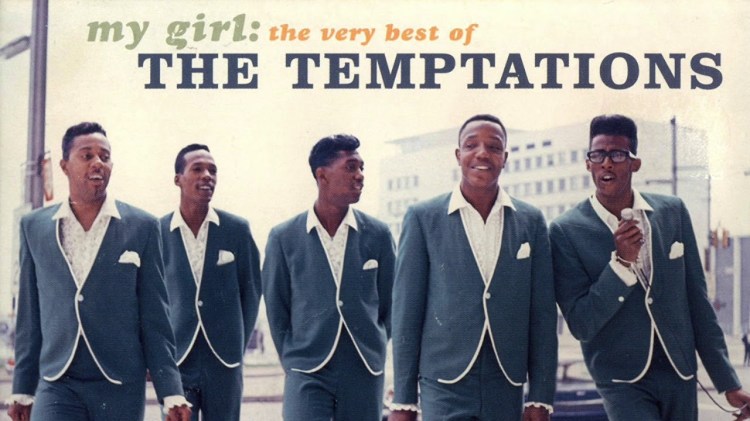
But my attention was focused when I heard “My Girl” for the first time. It was more than sunshine on a cloudy day. It was like finding something I never realized I couldn’t live without. Every time I heard that song it was the same first time magic.
Don’t you love those suits?
After that, I was constantly dragging my mom to the store to buy 45s.
A few years later, I heard “Round About” by Yes. It was the bass line that blew me away, but the whole song had sincerity, energy and great playing. Strangely enough, it was not Motown. Shortly after that, “Reelin’ In the Years” by Steely Dan appeared out of nowhere. It was that guitar work that blew me away this time. I never heard anything like that on top forty either.
One evening when I should have been in bed, I heard a DJ named Gene Shepard. He did not play any music; he told stories, oddball stories. They were really cool because I felt like he was telling them just to me.
Late into the night, I could not stop listening to that voice coming out of the radio.
Shepard in full story-telling mode, somewhere in the 1960s.
Then my friend’s older brother told me about FM radio.
Stations were playing entire album sides on FM radio.
The hip crowd was listening to cool jazz, and free-form jazz on FM radio.
University professors from Fordham and NYU with elbow patches on their tweed sport coats were listening to entire symphonies on FM radio.
You could listen to news from around the world on FM radio.
After that, I was constantly dragging my mom to the store to buy albums that I could play on my dad’s KLH wood-trimmed turntable.
The design was a lot more sophisticated then I remember.
When we moved out of the city into the country, I scraped enough money together to buy my own FM radio.
I could not find Gene Shepard in that universe on the dial, but I found Vin Scelsa on WNEW. He played extended versions and live versions of those new rock songs I was listening to. He told oddball stories too.
Thanks to the New Radio Archives.
My radio world was changed forever.
I was changed forever.
Those two and half minute miracles I was buying from the record store were just distant memories as I plowed headlong into the new acoustical territories of the King Biscuit Flour Hour, The Hearts of Space, and New Sounds on WNYC.
Towards the end of my radio listening career the Schickele Mix was a favorite, although I only listen to a few because it aired at an inconvenient time. I recall one in particular were he had transcribed a Monk song, note for note, and had a classical pianist play it. I sounded like a different song!
Those days may be long gone, but the memories they constructed in my young psyche will always be there.
I can still recall the radio blaring out the segway of Scelsa’s “The Heroes of Rock and Roll” into Springsteen’s “Born To Run” as I drove home from work in my light blue VW Beetle.
Yes, that was an epic, sonic journey from the top of the refrigerator to Schickele Mix. It is a journey I cherish to this moment.
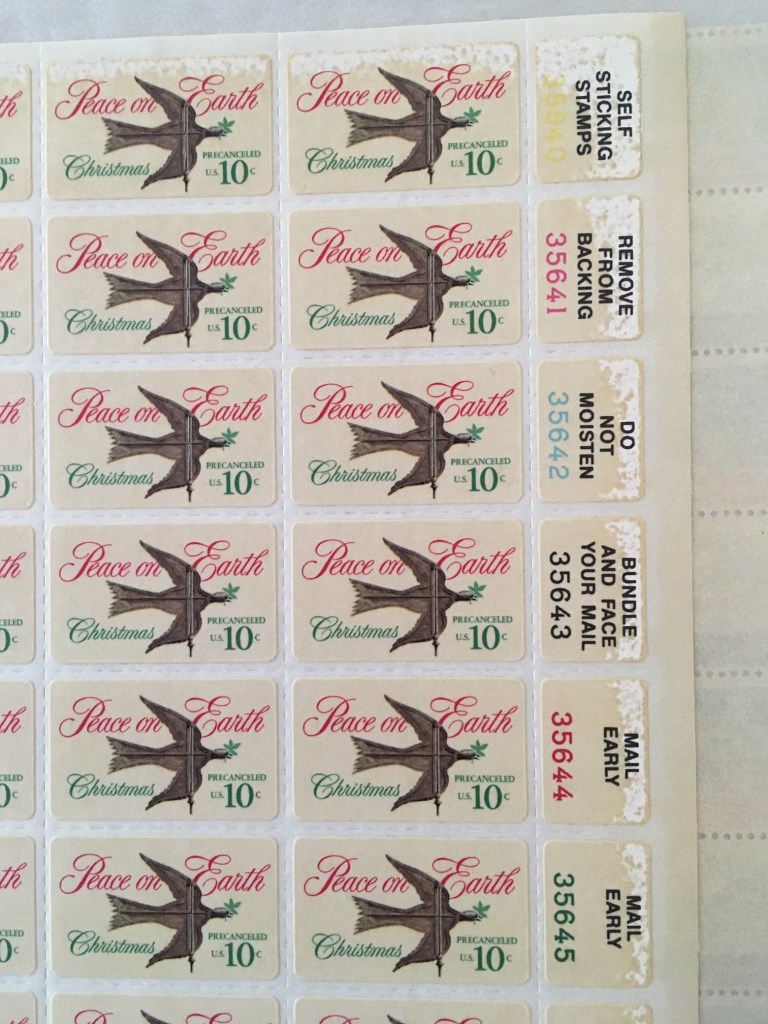
This week we feature the Traditional Christmas: Peace on Earth Christmas issue from 1974. It was designed by Don Hedin and Robert Geissman and printed by the Bureau of Engraving and Printing. The die cut printing method was used.
This was the first stamp the U.S. Postal service issued that had a self adhesive backing. Self adhesive stamps would not supplant gummed stamps until the mid 1990’s.
Since it is the first of it’s kind, a break with one hundred and ninety seven years of U. S. Postal tradition, directions on how to use the stamps were printed on the right margin of the pane above the plate block numbers.
The plate block numbers and the ‘reminders’ on how to be a good postal office user, are little through threads that keep this new design with in postal tradition.
This holiday stamp brings up an interesting situation.
Over time , the adhesive in this issue has caused the background color to fade away. As of 2020, not all the stamps have been effected. It is odd that the 2017 Scott’s catalog does not refer to the effected stamps as an error. No separate price is given. As far as I can tell, sellers are following the lead of the Scott’s catalog.
(I would consult the 2019 catalog but the library on the archipelago is still closed. If one could participate in social distancing it would be at our libraries.)
Since the choice of the problematic adhesive, or ink, was that of the designer, would it not be an error for the effected stamps?
The temperature on the Midwest Archipelago is finally warming up. That means the days of cooking in the oven are growing short.
All the apple, pumpkin, and key lime pies, the blueberry buckles and apricot scones will all be saved for autumn and the holidays.
Soon the marinated chicken and swordfish; the big, juicy cuts of steaks; the vegetables, mushrooms and the baby heads of greens will be on the Weber.
Bruschetta; roasted red pepper salad on grilled crusty bread; cool piles of seafood salad tossed in olive oil, parsley and lemon; clams on the half shell; oysters on the half shell; and a thousand little bits of summer flavors sprinkled on top will fill our dinner table on the porch between the beer on ice and the tall bottles of white wine.
The thought of it makes me want to go back into the restaurant business so that I can cook all day long and watch happy people eat and talk.
But before this is the order of the day. I wanted stuffed mushrooms one more time.
My mushroom stuffing is a simple balance of three flavors:
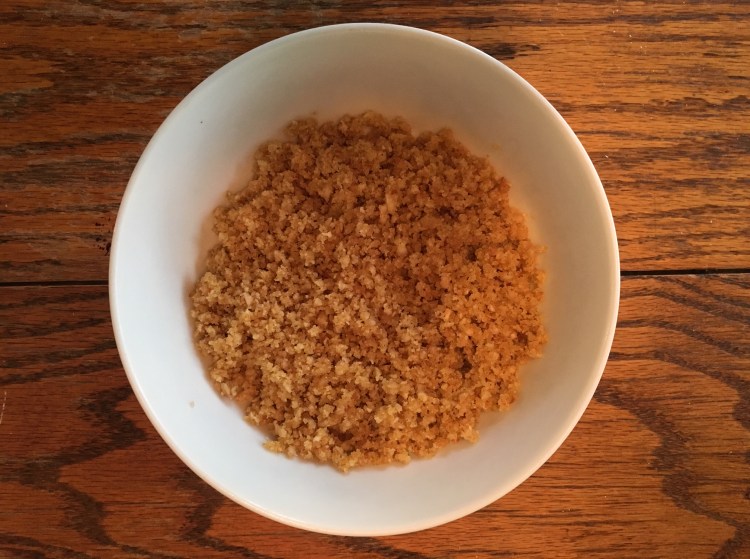
mushroom stems, finely minced
good bread crumbs
good olive oil
DON’T use HUGE mushrooms; they take too long to cook.
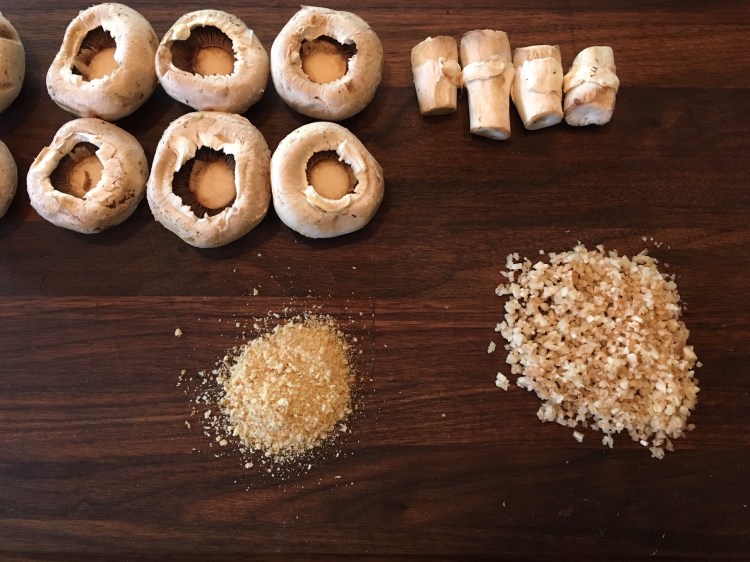
Always mince the stems of the mushrooms with your chef knife. (The pile on the right.) The blade of the food processor spins way too fast to keep the integrity of the stems – unless you know something I don’t about using one.
Each large-ish mushroom uses about 1.5 – 2 tablespoons of stuffing.
Add the olive oil to the bread crumbs and minced stems a little at a time. Mix it with two forks held together, side by side. I have tried mixing this with a dozen different implements but my patent pending, two fork method is the best I have found.
The mix should have about the consistency of wet sand and look like this. Just enough oil to make it come together but still be somewhat fluffy. Don’t forget to season it.
I use a tablespoon to form the pile of filling in the cap of that forest floor delight. Make sure you lightly oil the pan you are baking them in, and leave enough room around them to get them out.
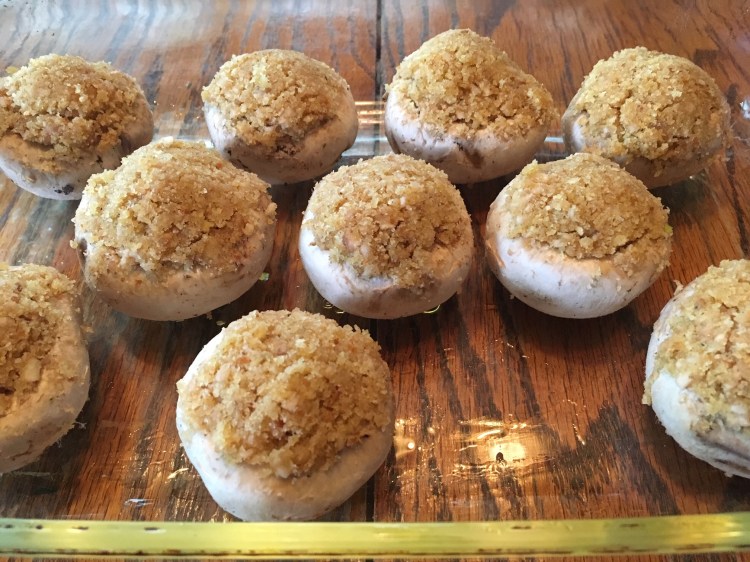
Bake uncovered in the oven at 375 – 385 F. Takes about twenty minutes. Check them often.
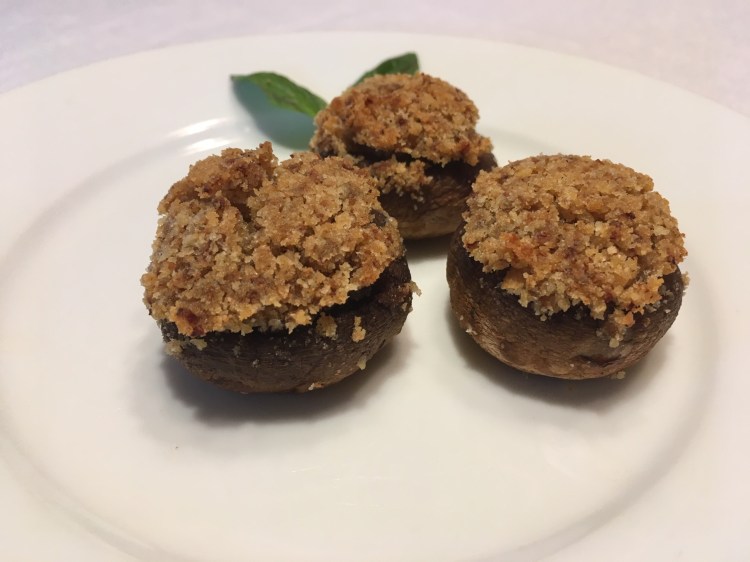
This is what you get when they are done.
The bread crumbs should be slightly browned and the mushrooms wrinkled around the sides.
What adult beverage is a natural pair with this?
An Orvieto, Sauve, or Vernaccia
Dry Creek Savignon Blanc is my wife’s favorite pairing
This will stand up to a well oaked Chardonnay too.
Beer-wise, anything from a lite Pilsner to a brown English ale or a dark Germany Bock beer.
Sparkling apple cider or a local hard cider would work too.
When I started cooking in commercial kitchens it was a time of transition in American eating habits. The beef-concentric, ‘more is better,’ dining ethos was shifting to lighter, healthier fare.
I have always felt it started with the health and the organic food movement. In the 1970s, these were becoming less and less a ‘fringe’ lifestyle. Both made their way into the restaurant scene through the cooking of Alice Waters, Jeremy Towers, and Wolfgang Puck – the creators of California Cuisine.
Essentially, these chefs were building on the French Novel Cuisine movement that Paul Bocuse, Alain Chapel, and Jean and Pierre Troisgros, among others, had started a decade earlier.
On a third front, Giuliano Bugialli and Marcella Hazan’s cookbooks of the 1970s were showing the American dining public, and a younger generation of Italian-Americans, that not every Italian dish should be covered in tomato sauce.
Eating healthy and cooking with fresh ingredients was something that many Italian families did not lose when they moved from Italy to America. But these culinary movements helped to bring the authentic cooking of our families to a wider audience, in addition to diversifying menus in countless restaurants.
Salads always played a big part in the tradition, new and old, of eating well.
Over the years my staple salads have changed a lot.
First they were a small course topped with some combination of sliced onions, mushrooms, tomatoes, and alpha or bean sprouts, usually on a romaine and iceberg lettuce combo with a little sliced up endive thrown in. There was a different dressing every week.
Then, sliced apples and radishes with an apple cider and tarragon vinaigrette dressing was the regular. The predominate green was bib with shredded romaine for crunch.
In the later 80s, I rediscovered my Italian roots – combinations of sun-dried tomatoes, olives, capers and shaved Parmigiano-Reggiano found their way onto the table more often than not. It was back to romaine lettuce with radicchio and chicory mixed in. A balsamic and olive oil vinaigrette was the standard dressing.
Occasionally, I would get away from this and use walnut oil, fig vinegar or rice wine vinegar to dress the crumbled Gorgonzola, sliced pairs, walnuts or figs on the bed of spring greens or just arugula.
A few years later I discovered that root vegetables were nature’s vitamin pills. I was getting older and I felt I needed more vitamins than protein.
The salads got larger and root vegetables of every kind landed on top. Some grilled, some raw and a few fried for a crisp finish.
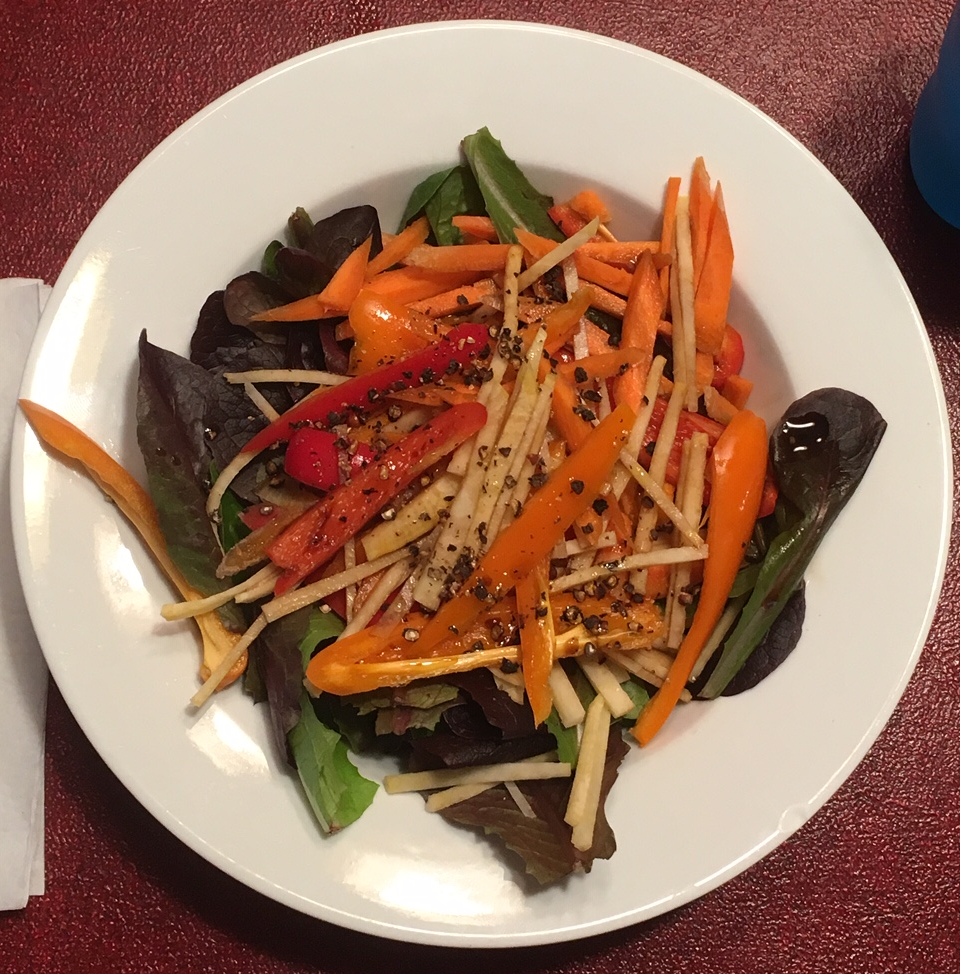
That brings me up to the last few years and my latest version of a salad – greens with crudites on top. In addition to needing more vitamins, I have to work harder at keeping the weight off, even though I walk everyday at lunch, ride my bike after dinner and lift weights. Several days out of the week this big salad and crudites is my meal.
The standard mix is sweet baby peppers, carrots and rutabaga, all cut into large matchsticks and piled on a bed of mixed greens – a combination of above and below the ground. When I can, beet tops are shredded and mixed into the greens. Once in awhile, cracked black pepper, croutons, oil cured or Kalamata olives and sliced figs are mixed into the pile of vegetables.
It always has just balsamic vinegar and olive oil to finish.
One night I marinated the root vegetables in liquid smoke. That was interesting, and I am still working out the flavor details to make a memorable salad with them.
Looking back on all this, what variation is yet to come? Maybe it will include tubers soaked in liquid smoke or one type of leafy green sauteed in oil and garlic, cooled and mixed in with the uncooked greens.
Even with all the thinking I do about food, transitions between comfortable flavor combinations is slow and gradual for me. Must be my Roman Catholic upbringing.
Many of those ideas will not last long in my kitchen as I cook with them and find out what they have to offer.
A cold spring day in the archipelago requires something warm to eat.
Something to bring back good memories as well as fill the stomach.
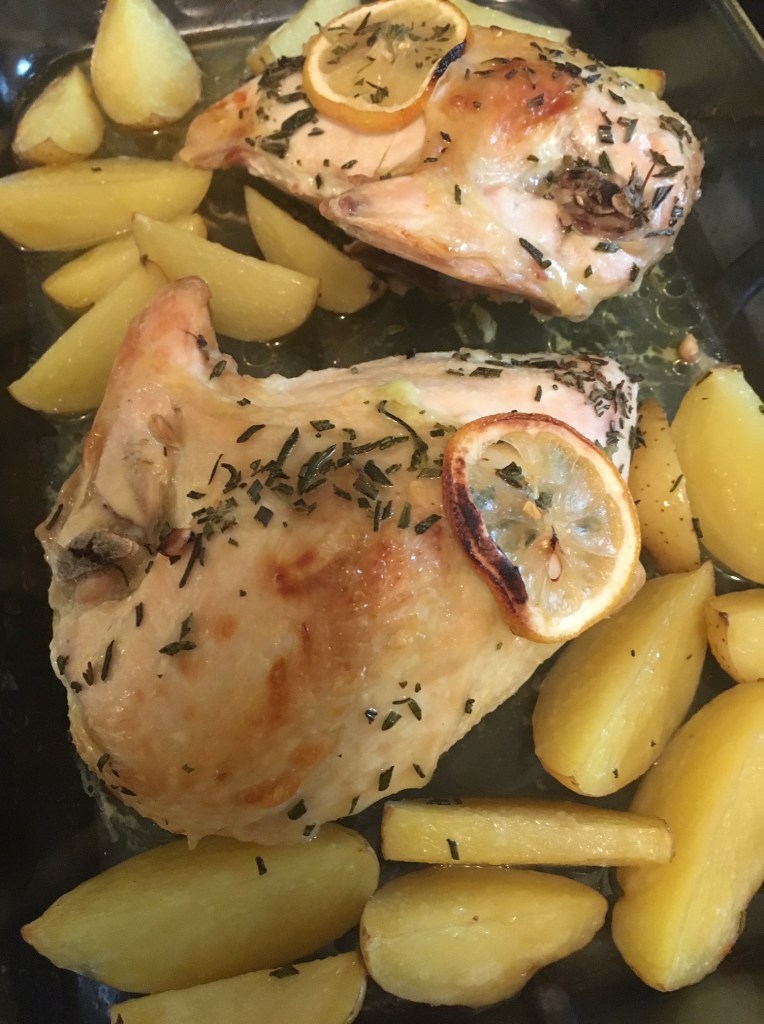
Chicken, lemon and rosemary; a dish my grandfather made for my mom, my mom made for us, now I make it for my family.
It’s simple, fulfilling and delicious too.
Under the skin of each split breast, slip a clove of garlic that you have crushed with the flat part of your chef knife.
Quarter four smallish Yukon Gold potatoes, along the long side. They should be no more then an inch thick at their widest part.
In a bowl, gentle toss the chicken and potatoes in a few ounces of olive oil.
Lightly brush the bottom of a roasting pan with olive oil. Place the breasts and the potatoes, all skin side up, in the pan.
Slice a lemon in half. Slice two rings off one half. The other piece cut in half and squeeze it on the chicken.
Take two long sprigs of rosemary and strip the leaves off the stem. Chop them well and sprinkle on the chicken and the potatoes. (I left the rosemary off the potatoes because the kids don’t like picking it off.) Season with salt & pepper and top with the two lemon slices.
Cover with foil and bake at 450 until 3/4 done. At that point take the foil off to crisp up the skin of the chicken. Cooking this with a cover keeps it moist. If you want it fully roasted, cook without a cover at 400. If it is getting too crispy, add a few tablespoons of water to the pan and cover with foil.
When you serve it, spoon the juice from the pan over it. Yes, it is full of chicken fat, but that has wounder flavor you won’t want to pass up.
A light white, of any kind pairs well. Even a semi sweet Riesling would work, as long as it has good acid.
Don’t forget the crusty bread to sop up the pan drippings.
Don’t forget to say grace. If we can sit at a table and eat a meal, then we have a lot to thank God for.
FOOTNOTES:
The split breast in the photo are large. They made four servings. (Not the best photo but we were in a hurry to eat.)
Other herbs can be mixed in too – thyme or oregano on the stem, chiffonade of basil, bay leaves (fresh if you can get it) broken into large pieces.You can leave the rosemary whole too. If you use whole herbs, let them stay on the chicken for a few hours before it goes in the oven. ( Store wrapped, away from other foods on the bottom self of your refrigerator until time to cook it.)












 Prairie Beacon