
Prairie-Beacon will be back sometime in July!
See you then.

Prairie-Beacon will be back sometime in July!
See you then.
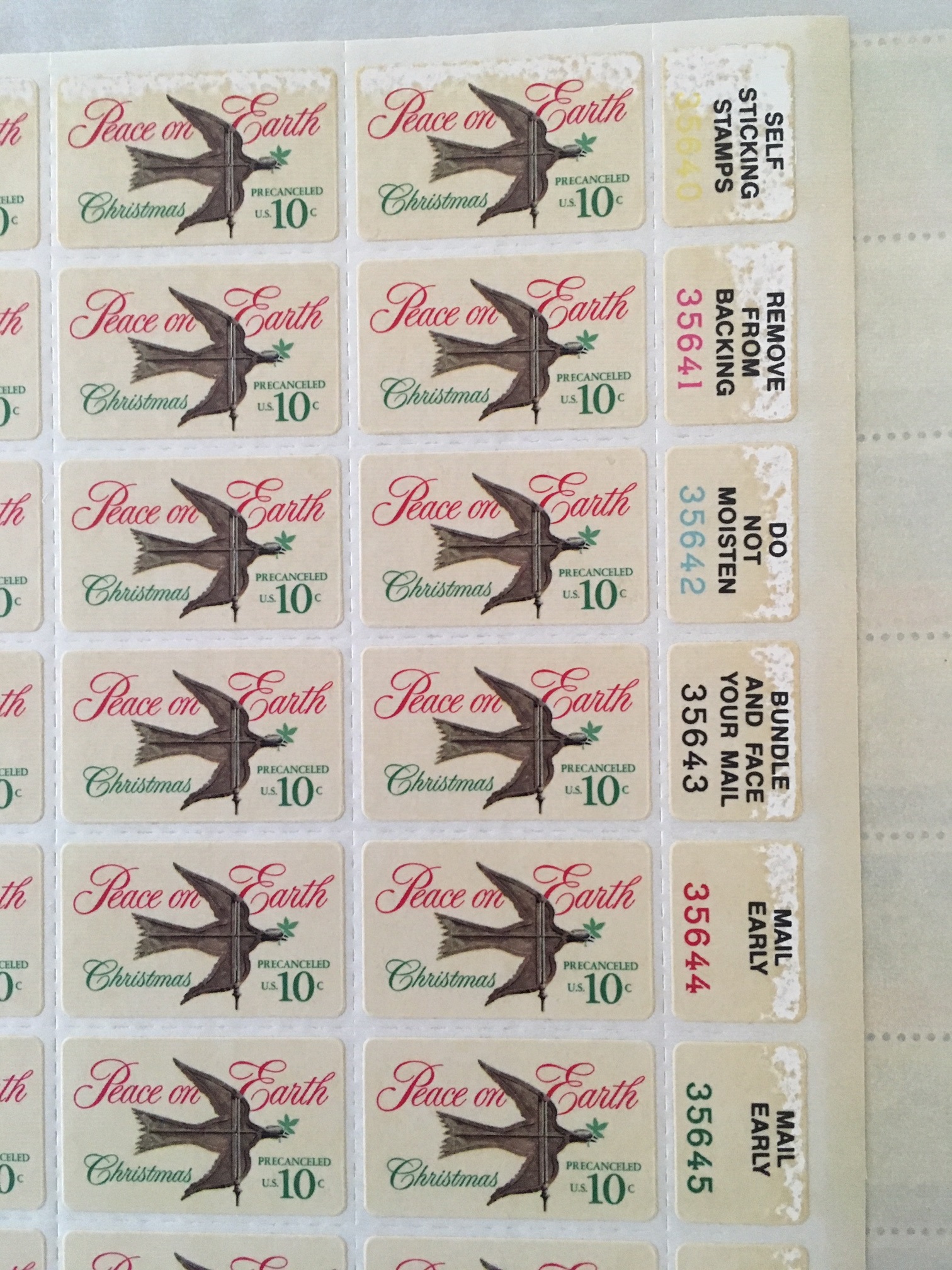
My original intention of a Stamp of the Week post was to take a stamp in my collection, post an image of it and point out a few facts. A five minute philatelic escape, a moment to share my passion with other collectors. Simple enough. But as we know, each stamp has a deep and long history. The first self adhesive issue was no exception. Here is more information on the stamp that changed U S Postal Issues forever.
Avery Dennison, the giant, multi international label maker worked with the U.S. Postal Service to develop this stamps. Since Avery Dennison pioneered the shelf adhesive label in the 1930’s, who better to work on this project? Unfortunately, they encountered technical problems with the adhesive bleeding through the paper and discoloring the printed image.
The discoloration problem, and the lack of perforations, received complaints and printing more issues of self adhesives was stalled. It seems that the majority of complaints came from collectors, still a formidable share of the stamp purchasing public in the 1970’s.
It was not until 1989 that the next self adhesive was issue. American Bank Note Company printed this issue, without any adhesive problems to date.
In the same year Avery Dennison signed a multi-million dollar research and development contract with the U S Postal Service to develop self adhesive stamps and machines to dispense them. In 1995 they were back to printing self adhesive stamps for the U S Postal Service.
Adding old fashion perforations to self adhesives appeared to have been a part of this research contract as well. The Flag Over Porch issue below was the first.

Love them or not, all stamps issued by the U S Postal Service are self adhesives. (If I was twenty years old, I would consider starting an Occupy the Post Office movement to bring back the old stamps. No, we would not burn down the local post office; just stand in the lobby chanting engrave and perforate, engrave and perforate, until the post master general got tired of us and caved into our demands. Judging from the present political insanity, it may work!)
Evidently, a small group of companies print stamps for the U S Postal Service. As of this writing Avery Dennison appears to have the major share of that market.
That is an outstanding accomplishment for a company that lost big the first time out.
I also learned that the United States was not the first country to issue self adhesives. They were initially printed for countries located in tropical climates. Sierra Leone brought out an issue in 1964 and Tongo in 1969. It was a necessary change with the persistent humid conditions of those locations. With out the use of perforations, die cutting the stamps into unique shapes was much easier. This was exemplified in the Sierra Leone issue having the outline of the country.
On a related matter. The U S Postal Services Postage Stamp page gives facts about their stamps. It lists 1992 as the national roll out for self adhesive stamps. However, it does not mention the issues that came before this date.
Happy Collecting!
For a lot of people summer eating means big, thick steaks sizzling on the charcoal grill. That goes on in our backyard too but not as often as some of my friends and neighbors.
The essence of summer cooking for me is a great seafood dish paired with a simple, lite white wine or sparkling pilsner beer.
The classic summer dish is a combination of shell fish and fin fish, cooked in a covered pot. It is usual flavored with some combination of sautes vegetables, fresh herbs and a splash of white or red wine. If tomatoes are used, and a heavy flavor is the order of the day, then red wine is used. If tomatoes were not included, and the flavors are to be lite, then always white wine. I serve it over thin vermicelli pasta or some type of rice; red, black, or medium grain white.
This culinary idea of summer is welded into my mind from childhood. In the hieght of the city heat my dad would drive us to City Island for clams on the half shell, fried calamari and other seafood treats. City Island is a small piece of suburbia out in East Chester Bay. It is tucked away in that strange little convolution of ocean inlets where Eastern Long Island meets the coast line of New York State.
There were a few times too when my dad had gone on a business trip and my Uncle Jim DiScillio took us to Vincent’s Clam Bar in Little Italy for dinner. We drove into the city in his red 1965 Impala convertible. That was a big thrill for me when I was ten years old.
That culinary image of summer was further ingrained into my memory when I took my first real cooking job at the now defunct Aldo’s Restaurant in Middletown NY. Aldo made awesome pizza and his wife Phillis had the magic touch when it came to shell fish combinations cooked in a pot. Whether it was seafood fra’diavolo pile up on a hill of linguine, or a buttery broth flavored with white wine, garlic, parsley, butter, they were to die for!
Every time I made one of those I thought of summer, even if it was the middle of winter with sixteen inches of snow on the ground.
I don’t have complete recipes for any one of these dishes. They are a variation of one recipe, similar to what Phillis showed me how to make forty one years ago. What makes them different is that I start each one with the same question; What flavors am I thinking about today? Once I answer that question, the steps from one stage of the creative process to the next find their own way as I shop and cook.
After chefing professionally for most of my life, cooking is like a seasoned musician playing a solo over a well loved cord progression. Like the musician, all the required cooking skills, knife skills, and the knowledge of a favorite list of ingredient have been completely integrated into my thinking. I only spend time imagining possibilities and how to get there.
Interestingly, when I started out I thought that only major changes in ingredients and cooking methods resulted in major changes in the final product. Now I understand that making several small changes in ingredients and cooking methods can dramatically transform what is located on the end of your fork. This is now my preferred method of keeping meals interesting.
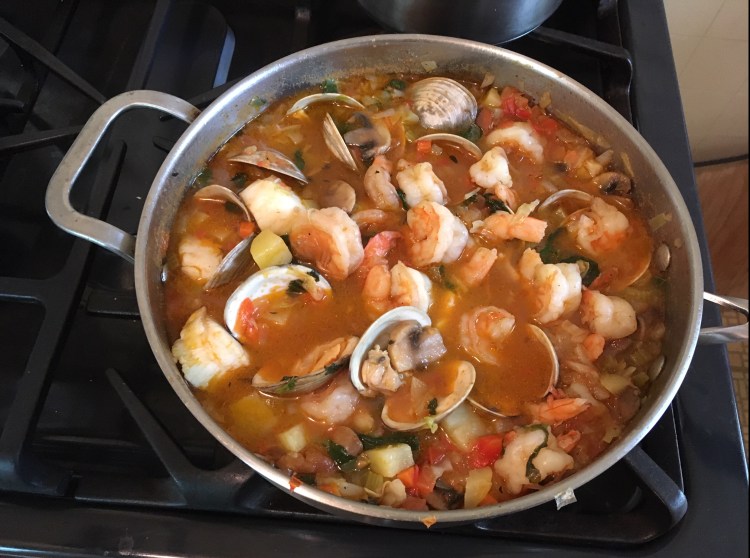


A good example of this is the two dishes in the photos above. There is only a difference of three ingredients between them, including the different starch used to serve them on. They have the same two cooking techniques, sauteing and simmering, but greater emphasis was placed on sauteing over simmering in dish number two.
Photo one’s ingredients: baby clams, diver scallops, cold water shrimp, garlic, onions, mushrooms, spinach, tomatoes, olive oil, white wine and fresh basil. It was served on red rice.
This dish is lite on saute and heavy on simmering. The garlic, mushrooms and onions were saute in the olive oil. The spinach was added next until it was wilted. Then the tomatoes were added for a minute. To finish, I added the rest of the ingredients, covered the pot and simmered until the clams were open and shrimp cooked.
For the second dish the scallops were substituted with sockeye salmon. The shrimp and salmon were dredged in flour (flour being the second change of ingredients) before they were simmered with the other ingredients. The third change was serving it on vermicelli pasta.
Flour, even a small amount, can greatly transform the character of a dish. Here it thickened the liquid and also put a thin batter-like coating on the salmon and shrimp. Both big changes in mouth feel and flavor.
On the technique side I did a lot more sauteing then simmering. The shrimp and salmon were sauteed in olive oil. I set them aside along with the drippings I scraped off the bottom of the saute pan with a rubber spat. That is the flavor treasurer the french call fond de glaze. Never tossed it aside, hoard it at all costs!
In a separate pan I sauteed the garlic and mushrooms in olive oil. I added the spinach long enough to wilt it.
Then I took the oil from both pans and sautes the diced tomatoes in it ; several minutes for that.
Finally, all the ingredients were combined. The Fond de glaze was gently mixed into the liquid and this summer seafood combo was simmered in the pot under a lid. When it was done it went over a pile of vermicelli pasts.
Both look similar with their reddish color and big pieces of fish . But those simple changes made enough variation in the two dishes that they could no longer be called by one name.
The fist one was like a flavorful fish soup that makes you want to eat more because it is lite in texture. The second is almost a fish stew with more body due to the flour. Sauteing more of the ingredients added deeper flavor notes to the broth as well as an under lying toasted note. This in combination with the flour satisfied our appetites much faster then the previous version.
These are just two versions of the summer fish dinner. But these are the two that the family likes the most. Cooking for my family is about sharing my love with them as well as eating, so these get made a lot.
Happy cooking and don’t forget to say grace.
I have a few other seafood variations that will appear in a second post.
When my son was in the cub scouts they had to visit the local police station to earn a badge.
The information officer gave them a tour, which included the line-up room where witnesses and victims picked out criminal suspects. He explained to the scouts that the person doing the picking could not be seen by the suspects.
Most of the scouts seemed to be confused by this concept. The information officer asked the scouts if they would like to stand in the line up so they could see what he just explained.
Excitedly, they all said yes.
Then he asked the nearest dad if he would lead them in, while the officer stepped to the microphone and talked to the kids on the other side of the one-way glass window.
With a chuckle the officer said, “This is the most popular photo op of the tour. Get out your phones dads.”
The dad who lead the scouts into the line-up room declined the offer because his battery was low. But he stood by the scouts, ready to lead them back out of the room.
His decision made for an interesting photo.
‘Undercover sting operation finally nabs Girl Scout cookie thieves!”

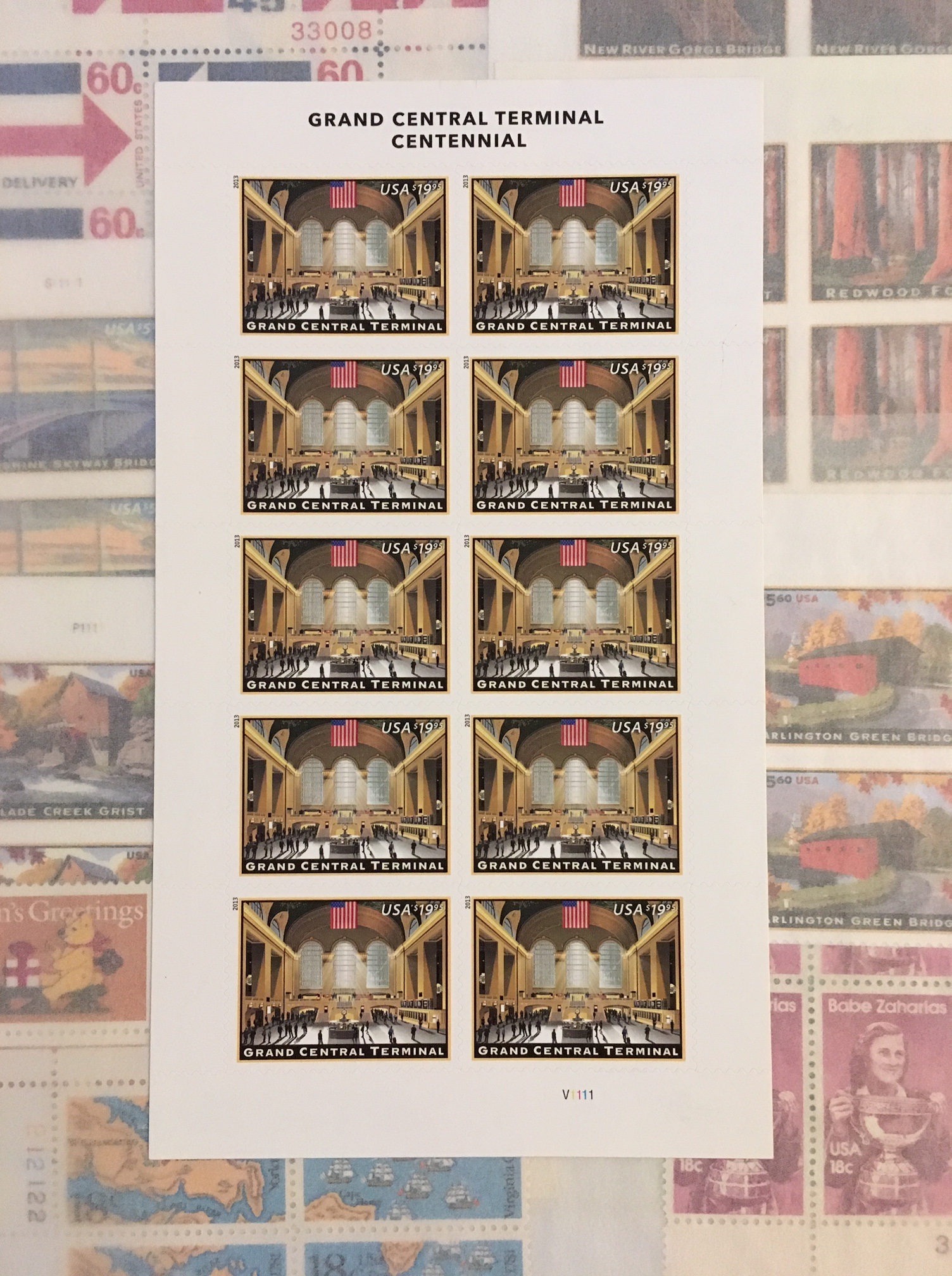
This week we feature the Priority Express Mail Stamp Grand Central Terminal, New York. It is part of the American Land Marks Series launched in 2008. It was designed by Derry Noyes and Phil Jordan. The print run of 3,000,000 stamps was done with the photogravure process. The printer was Avery Dennison. These stamps were printed at the company’s Security Printing Division plant in Clinton S.C. These issues have the highest face value of any U.S. Postal Service stamp.
The rate of $19.95 entitles the parcel or document to be send via the EMS system. This is an international postal Express Mail Service, offered by postal operators of the Universal Postal Union. It is an expedited delivery system with faster delivery times then regular mail service and is delivered seven days a week.
The U.S. Postal Service Joined the EMS system in 1999, which covers 180 countries and territories.
A sender can enjoy this same expiated delivery in domestic service by purchasing the Priority Mail Stamp for the rate of $5.60. The Arlington Green Bridge issue, pictured below, is an example of the domestic service stamp in the American Landmarks Series.

From 1885 to 1971 the U.S. Postal service issue special delivery stamps, a similar service to the Priority Mail Stamp. Why this service was discounted until 2008 I have yet to find out. I will continue to research that question.
On a personal note, purchasing a sheet of these stamps gets a few comments from my wife when she goes over the credit card statement. She is the family banker. However, I am grateful that she tolerates my collecting obsession.
(Thanks for supporting your man baby!)
As always, happy collecting!
Taking a break from office work, I found myself looking at my stock books full of stamps – again. As I moved the big magnifying glass from one stamp to another, my mind went into ‘what if’ mode.
For a few minutes I was in charge of the stamp designing department of the United States Post Office. I imagined that the post master general instructed me to design new, innovative stamps. Sales were down and collectors were clamoring for a fresh approach to issues that were looking tired and unimaginative. She told me not to consider the cost of producing them or the practicality in using them. “The post office needs to sell more stamps, period!” she exclaimed.
I also imagined she hired me in at 250K a year.
Agreeing, I quickly worked on devising a plan to save the postal service! Innovation was key, novelty a necessity, and enthralling the philatelic aficionado was the order of the day. I had to boldly go where no stamp designer had gone before.

I fancied myself to be the Gerald McGrew of the philatelic world (He is the little boy in the Dr. Seuss book McGrew Zoo. Gerald visits his local zoo and is underwhelmed with the selection of animals. He imagines he owns the place and then proceeds to fill it with his notions of exotic animals.)
Before I could finish my PB & J on white bread, I had racked up more groundbreaking designs than any print plate scribe in philatelic history.
Here are some of the stamps I designed as I sat in my palatial office at 1050 Connecticut Avenue, North Western Washington, DC.

A multi-colored issue commemorating errors. The run would be broken up into four separate, smaller runs. Each smaller run would have one particular error: color shift, inperf, perforation shift, and a missing color. The finishing touch would be just one sheet of four panes that has a major design error.
A stamp that can be folded along the perforations into a three dimensional object. When folded it shows a complete image. The first on would be of Manhattan. Each side of the box would have a view from each point on the compass. The top of the ‘box’ would show a view from above.
Then issue a Christmas commemorative that folded up into a three dimensional ornament for the Christmas tree. The hooks would be perforated into the margin of the pane.
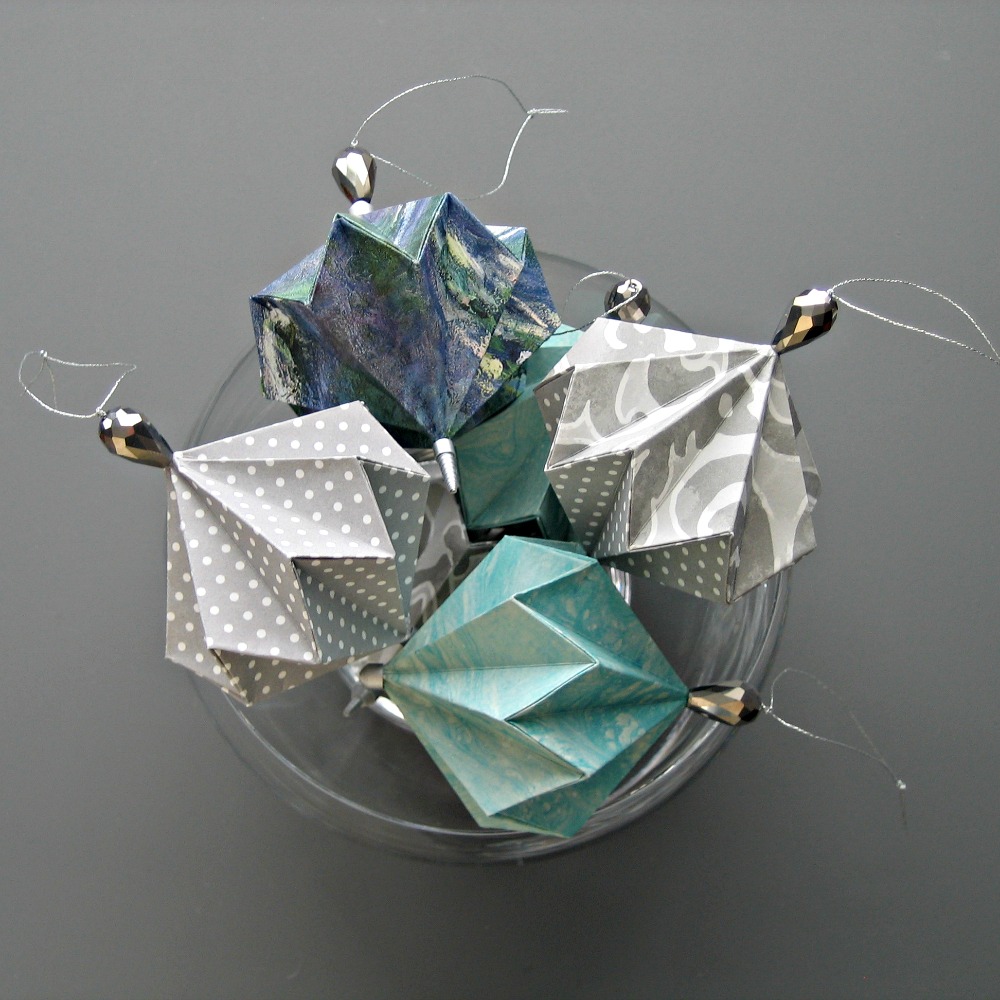
A round sheet of stamps. The stamps would be perforated in concentric rings, getting smaller in diameter until a disk shaped stamp was left in the center. Each ring would consist of several arch shaped stamps that would fit on a letter size envelope.
I would issue a second to commemorate Earth Day. The slightly flattened view of the Earth would be looking down from above the North Pole. Each country would be a stamp. The pane would be twice the size of a normal pane of perforated stamps.
An M.C. Escher tessellation commemorative issue. Each stamp in the pane is one shape in the tessellation. It would be neat, and fairly expensive, for the four panes in the full press sheet to create a complete scene. The wood cut Day and Night would work well for this.

A stamp drawn for you while you wait at the post office. You can call ahead and pick it up. The only pre-printed feature would be an ornate frame around the area to draw the image in. This would give it a traditional look that would help sell it too and older age group, fifty five years old and up, that uses stamps more often then the younger generations.

Well, there you have it, my five minute day dream about being the head stamp designer.
Happy Collecting !

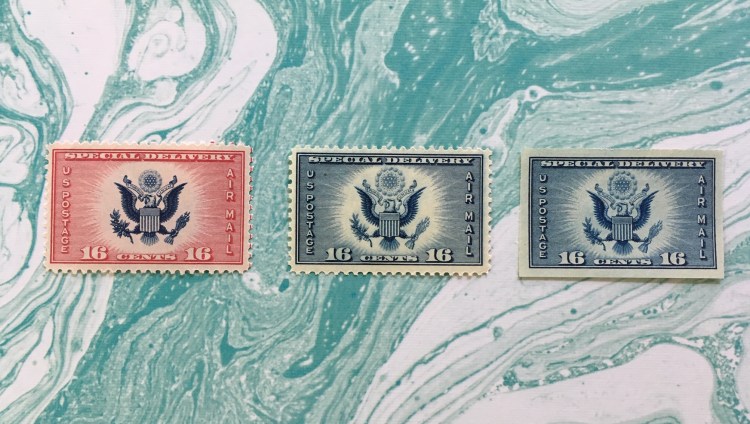
This week we feature the Air Post Special Delivery Stamp issue of 1934. The purpose of this issue was to combine the prepayment of air mail and special delivery service into one stamp. It had the same priority of a special delivery service, but was transported by airplane.
The special delivery charge entitled the purchaser to have their letter sent to its destination immediately after being dropped off at the post office. It did not have to wait until a ‘full packet’ was ready to be shipped to the post office handling its destination address.
This issue was a flat plate printing. 9,215,750 of the dark blue color scheme were printed. The inperferate version made it’s appearance in 1935. A second run of 72,517,850 stamps was done in 1936. The color scheme was changed to carmine and blue along with the great seal being slightly smaller than in the original printing.
This is the only instance were the U.S. Post Office has combined these two services.
U.S. special delivery services were discontinued in 1997. Air mail stamps, though not the method of transportation, were discontinued in 2012.
Deep collecting on this issue includes four known variations in the marginal markings. Also, several freaks and errors have been identified as well. I placed a bid on eBay for a fold over.
Presently, I am trying to find out who designed this issue. If anyone has any information on that, please share it.
The photo of these stamps was taken on a faux marble surface, similar to the marble counter of the post office in my home city of Yonkers where I bought many of my first stamps. It was built years before these stamps were issued.
Happy Collecting!
This past week I was filled with chefly energy and wound up cooking way more food then we could eat. It was piling up in the refrigerator. All the square plastic containers, with their red tops, made it look like a sea container port in there.
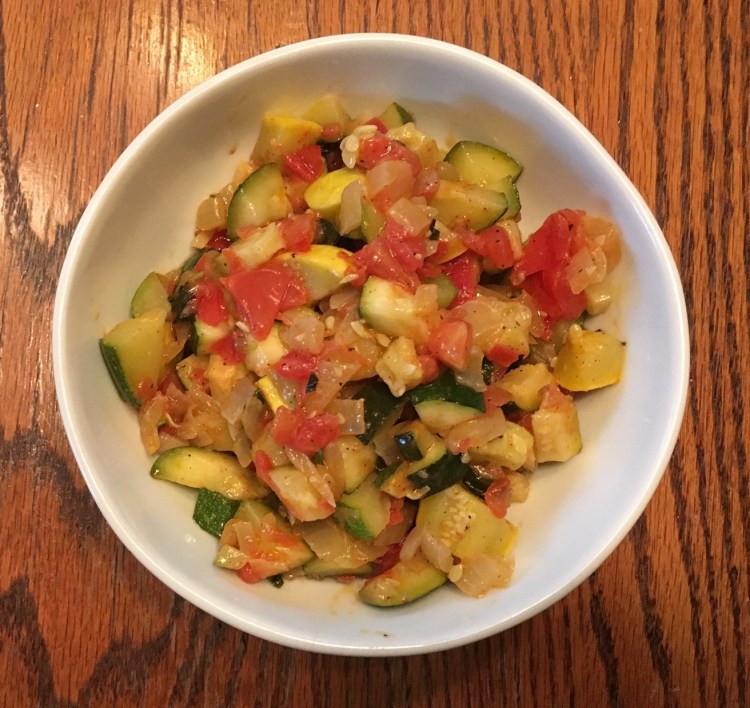
One dish I had a lot of was Ratatouille. I also had a large eggplant that did not get used.
Put the two together and you get Eggplant Roll-ups!
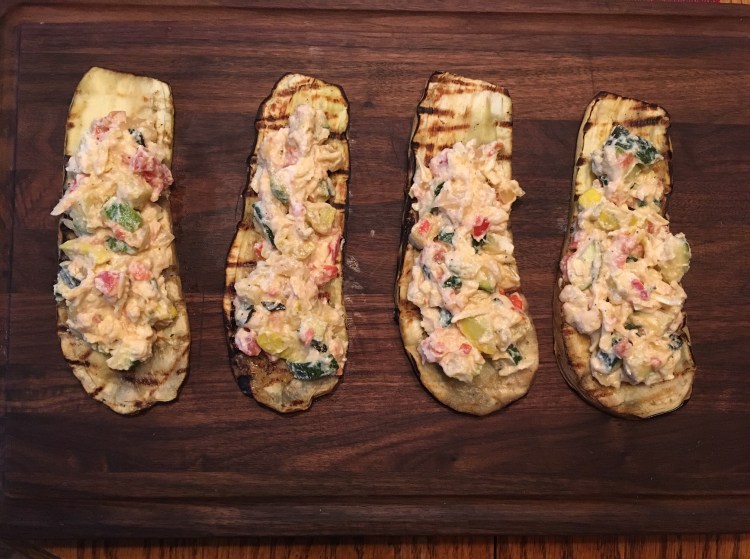
First thing I did was peel the eggplant, slice it thin the long way, and cook it on the charcoal grill. Brush with with olive oil and season lightly.

To make the filling I add ricotta cheese and a small amount of shredded Jarlsberg to the ratatouille; enough to hold it together. Season the mix with salt and pepper. Smoked Guda or Feta would be interesting too.

Each slice got a layer of the filling and rolled up.

When they went in the roasting pan I put several tablespoons of my home made tomato sauce under each one. Then I covered each one with a generous amount of the same. I sprinkled each with shredded mozzarella and baked at 365 until the cheese melted and they were hot inside. I did not cover them when they were baking.
If you want to cut down on the oven time you can heat the mix up in the microwave until it is warm.


The finished dish moments before I eat it!
Enjoy and don’t forget to say grace.
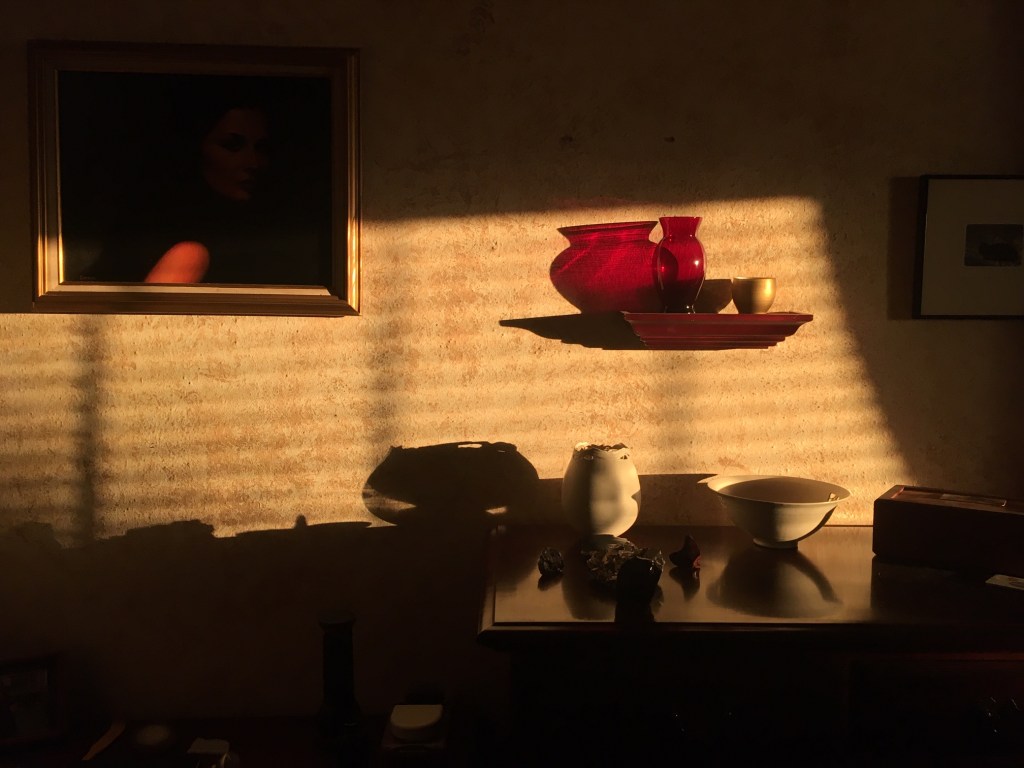

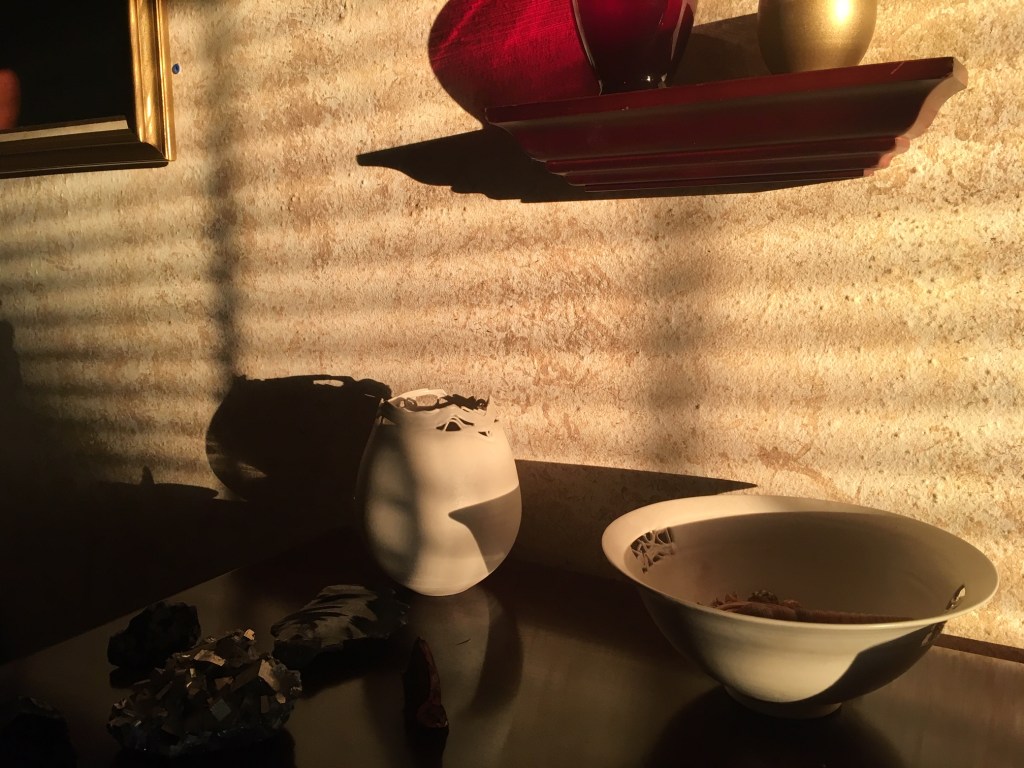
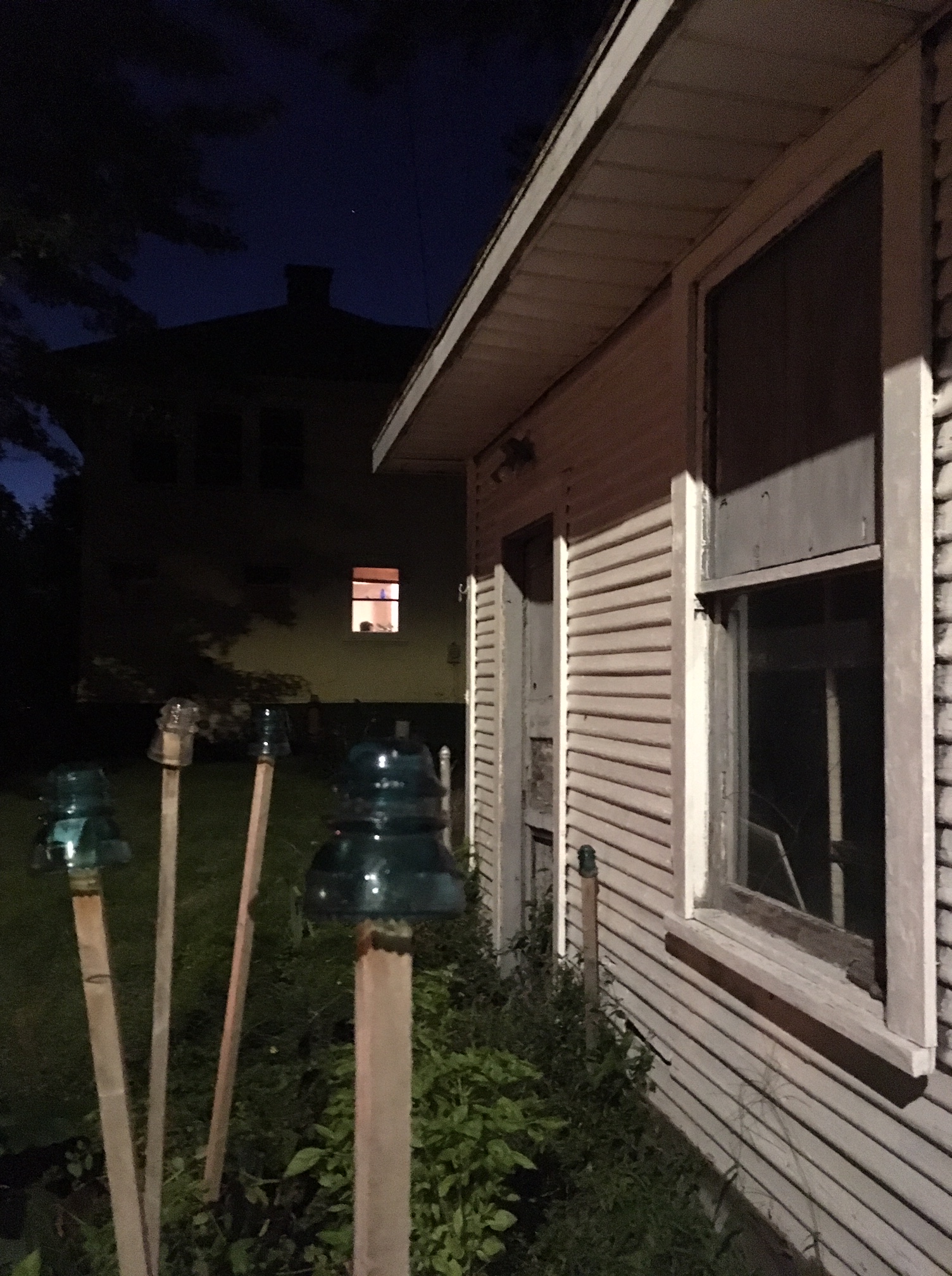
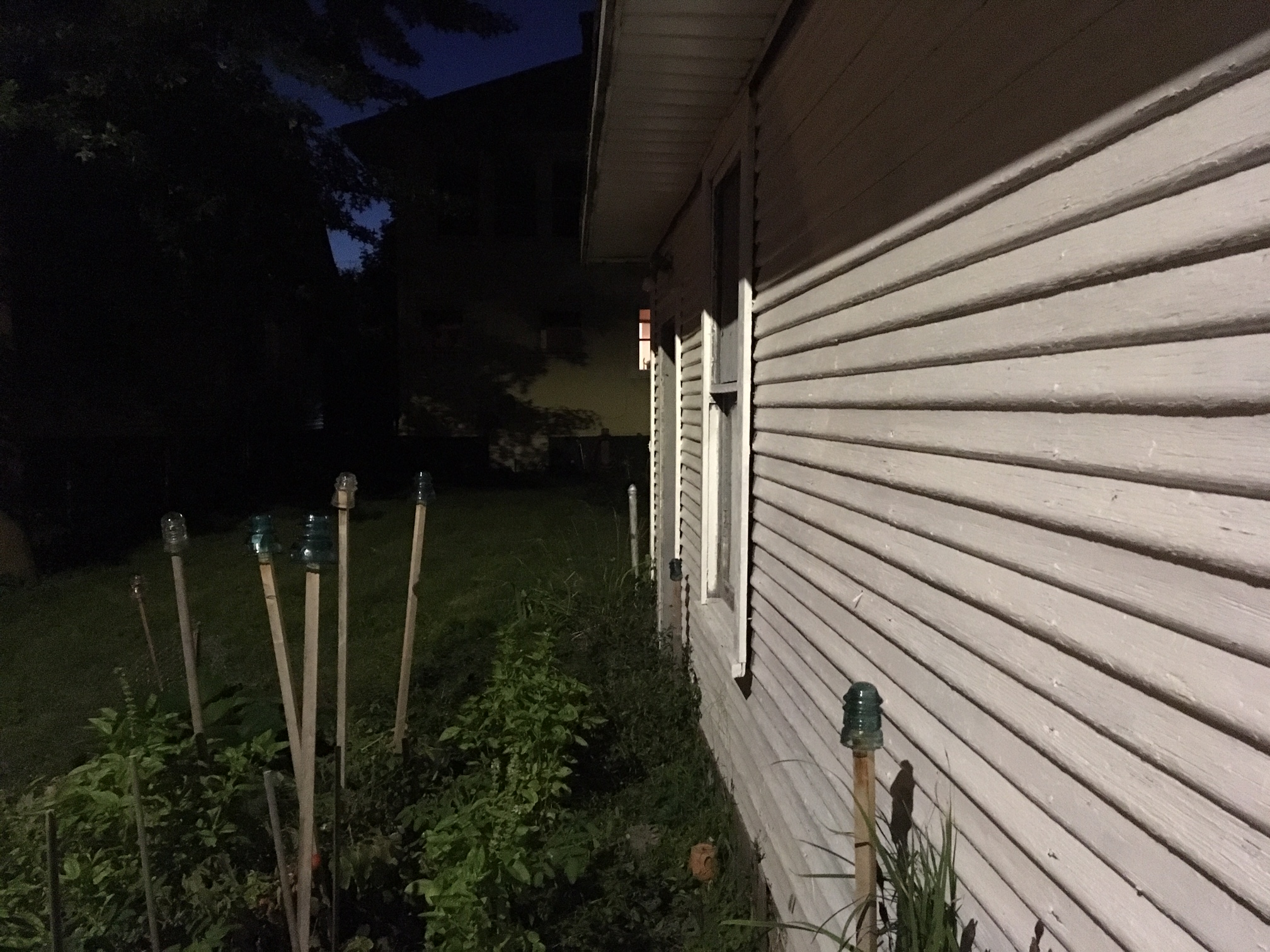
FOUR VIEWS OF A DREAM.

 Prairie Beacon